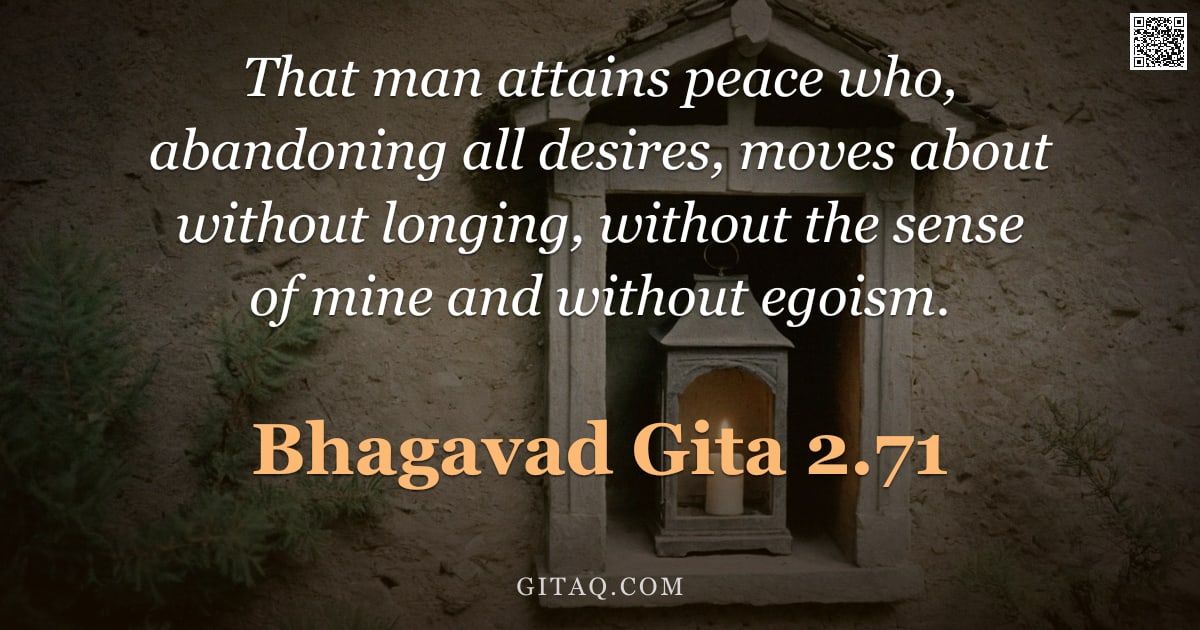
Bhagavad Gita 2.71
Sankhya Yoga · English Translation
विहाय कामान्यः सर्वान्पुमांश्चरति निःस्पृहः | निर्ममो निरहङ्कारः स शान्तिमधिगच्छति ||२-७१||
vihāya kāmānyaḥ sarvānpumāṃścarati niḥspṛhaḥ . nirmamo nirahaṅkāraḥ sa śāntimadhigacchati ||2-71||
What Does This Verse Mean?
In this verse, Lord Krishna describes the state of a person who has achieved inner peace by letting go of all selfish desires and attachment to outcomes. He explains that such an individual moves through life without feeling possessive over things or inflated by their own ego. The core teaching is that true tranquility comes not from getting what you want, but from freeing your mind from the constant craving for more.
The Teaching Behind It
This teaching is central to Karma Yoga (the yoga of action) and Sankhya philosophy within the Gita's framework. It develops the concept of 'Nishkama Karma' or selfless action, where one performs their duty without being driven by personal desires or egoistic identification with results.
Word by Word
Classical Commentary
Where This Happens
This verse appears in Chapter 2 of the Bhagavad Gita during the dialogue between Lord Krishna and Prince Arjuna on the battlefield of Kurukshetra. Just moments before this, Arjuna had expressed deep despair and confusion about fighting his own relatives, paralyzed by grief and attachment to them. Krishna has just begun explaining the eternal nature of the soul (Atman) and is now defining what a wise person looks like in action.
Living It Out Today
Consider a manager facing a critical project deadline where they feel overwhelmed by the need for personal credit or fear losing their job if it fails. Instead of obsessing over 'my' success or worrying about how others judge them, this verse suggests focusing entirely on performing the necessary tasks without attachment to the specific outcome. By letting go of that intense ego and craving for a perfect result, the manager can make clearer decisions and find calm amidst the chaos.
Explained for Children
Imagine a child who plays with toys just because it's fun, but doesn't get upset when they have to stop playing or lose their favorite game. This verse describes someone like that adult: they do everything without feeling like 'I must own this' or 'This is all about me.' When you stop worrying so much about what belongs to you and how special you are compared to others, your heart becomes quiet and happy, just like a calm pond.
Daily Reflection
Today, notice how often you cling to outcomes before they even happen; that tight grip is exactly what creates inner turbulence rather than peace. When you catch yourself thinking 'this is mine' or 'I must have this,' gently release the thought and return your attention to simple action without attachment. True freedom isn't found in getting everything you want, but in finding stillness within yourself regardless of whether desires are fulfilled.
A Practice for Today
Close your eyes and silently repeat, 'I act without longing for results,' letting the urge to possess or control dissolve with each breath. Visualize moving through your day like a clear river, flowing past obstacles of ego while remaining untouched by them.
Key Teachings
- The Art of Renouncing Desire
This verse teaches that peace is not a distant goal for the future, but an immediate state available when we stop chasing sensory gratification. It distinguishes between necessary action and being driven by insatiable cravings, showing how letting go of 'wanting' unlocks inner stillness. - Dissolving Ownership
The phrase 'nirmamo' invites us to question the deep-seated belief that our actions and possessions define who we are. By releasing the sense of ownership, we stop identifying as separate controllers and begin acting from a place of divine alignment rather than personal gain. - Transcending Ego
Nirahaṅkāra means moving without the burden of 'I-am-the-doer,' freeing us from the pride that leads to failure and the shame of perceived mistakes. When ego is set aside, our actions become pure instruments of duty, naturally leading to a mind settled in profound tranquility.
Themes
Related Verses
Read This Next
- 2.47 — This foundational verse on performing duty without attachment provides the necessary context for how one acts while abandoning desires.
- 3.30 — Reading this next helps understand the practical application of surrendering all actions to the Divine, complementing the renunciation mentioned in 2.71.
- 12.15 — This verse describes the qualities of a devotee who is dear to Krishna because they are free from envy and egoism, directly reflecting the state described in 2.71.
Recommended Reading
GitaQ earns from qualifying purchases as an Amazon Associate.