Bhagavad Gita 6.3
Dhyana Yoga · English Translation
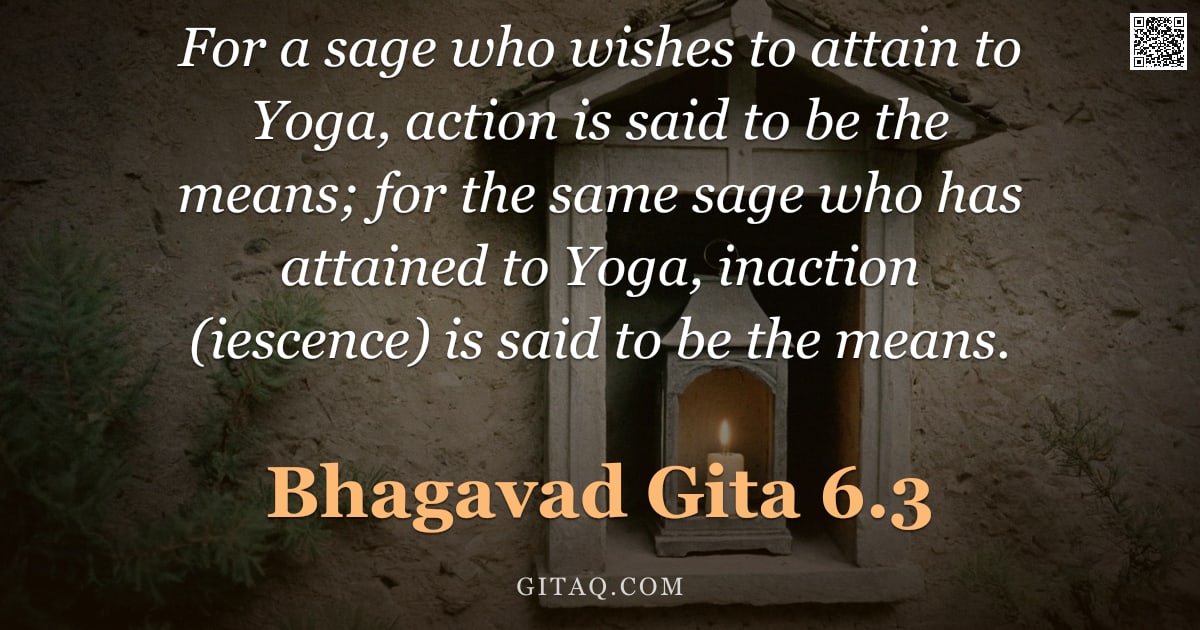
आरुरुक्षोर्मुनेर्योगं कर्म कारणमुच्यते | योगारूढस्य तस्यैव शमः कारणमुच्यते ||६-३||
ārurukṣormuneryogaṃ karma kāraṇamucyate . yogārūḍhasya tasyaiva śamaḥ kāraṇamucyate ||6-3||
What Does This Verse Mean?
In this verse, Lord Krishna explains the two stages of a spiritual seeker's journey to his student Arjuna. He teaches that for someone just starting their path toward meditation and inner peace, active duty and right action are essential tools. However, once that person has mastered yoga and found deep stillness within, letting go or cultivating mental tranquility becomes the primary means of sustaining that state.
The Teaching Behind It
This verse belongs to the synthesis of Karma Yoga and Dhyana Yoga within the Sankhya framework. It develops the concept that action is not separate from meditation but serves as its preparatory discipline, establishing a progressive path where external engagement transforms into internal mastery.
Word by Word
Classical Commentary
Where This Happens
This verse occurs in Chapter 6 of the Bhagavad Gita, set on the battlefield of Kurukshetra during a momentary lull in fighting. Lord Krishna is speaking directly to Arjuna, who has already received instruction on duty (Chapter 2) and knowledge (Chapters 3-4). At this specific point, Arjuna feels overwhelmed by the prospect of deep meditation while still entangled in worldly responsibilities; he asks how one can practice yoga when their mind seems restless. Krishna responds to clarify that action is not an obstacle but a necessary foundation for those just beginning.
Living It Out Today
Consider a professional who is stressed and anxious about meeting deadlines, feeling they cannot meditate because there are too many emails and meetings. In this stage, the application of Karma Yoga involves performing their work with full focus and dedication without worrying about the outcome, which naturally calms the mind over time. Once they have built enough discipline through action to find moments of inner quiet during tasks, they can transition to 'Shama' by intentionally pausing for mental stillness while continuing their duties.
Explained for Children
Imagine you want to climb a tall mountain; at first, you have to work very hard, putting one foot in front of the other. Krishna says this is like starting yoga: doing your duties and trying hard helps you get started. But once you reach the flat top of the mountain where it's quiet and peaceful, you don't need to climb anymore—you just sit there enjoying the view and staying calm.
Daily Reflection
Today, consider where you stand on this path of Yoga. If you are busy with duties, remember that Krishna calls these actions sacred tools for your growth, not obstacles to peace. But if you have found a moment of calm within yourself, honor it by letting go of the need to strive further in those moments and simply dwell in that quiet presence.
A Practice for Today
Begin by acknowledging your current stage on the spiritual path, whether you are still engaging with the world of action or finding peace within yourself. Sit quietly and offer a silent dedication: if you feel restless in work, let that effort be your offering to the Divine; if you find inner silence, rest gently in that stillness as your true practice.
Key Teachings
- Action as the Ladder
For seekers just beginning their journey, disciplined action (Karma Yoga) is essential because it purifies the mind and builds the focus required for meditation. Without this initial engagement with duty, the restless mind cannot settle into the stillness needed for higher realization. - Stillness as the Destination
Once a sage has stabilized in Yoga through practice, external actions become secondary to inner equanimity (Shama). At this stage, silence and self-restraint are not just means but the very substance of one's spiritual life. - The Continuum of Practice
Krishna does not present action and stillness as opposites, but as sequential stages in a single unfolding process. What serves you now (action) will eventually transform into what sustains you later (stillness), guiding the seeker from struggle to grace.
Themes
Related Verses
Read This Next
- 2.47 — Read this next to understand the foundational principle of performing duty without attachment to results.
- 3.30 — This verse expands on dedicating all actions to Krishna, which is essential for purifying the mind as described in 6.3.
- 12.15 — Explore this description of a devotee who has attained inner peace and equanimity, representing the state of 'Yoga-arudha' mentioned here.
Recommended Reading
GitaQ earns from qualifying purchases as an Amazon Associate.