Bhagavad Gita 18.17

Moksha Sanyasa Yoga · Deutsche Übersetzung
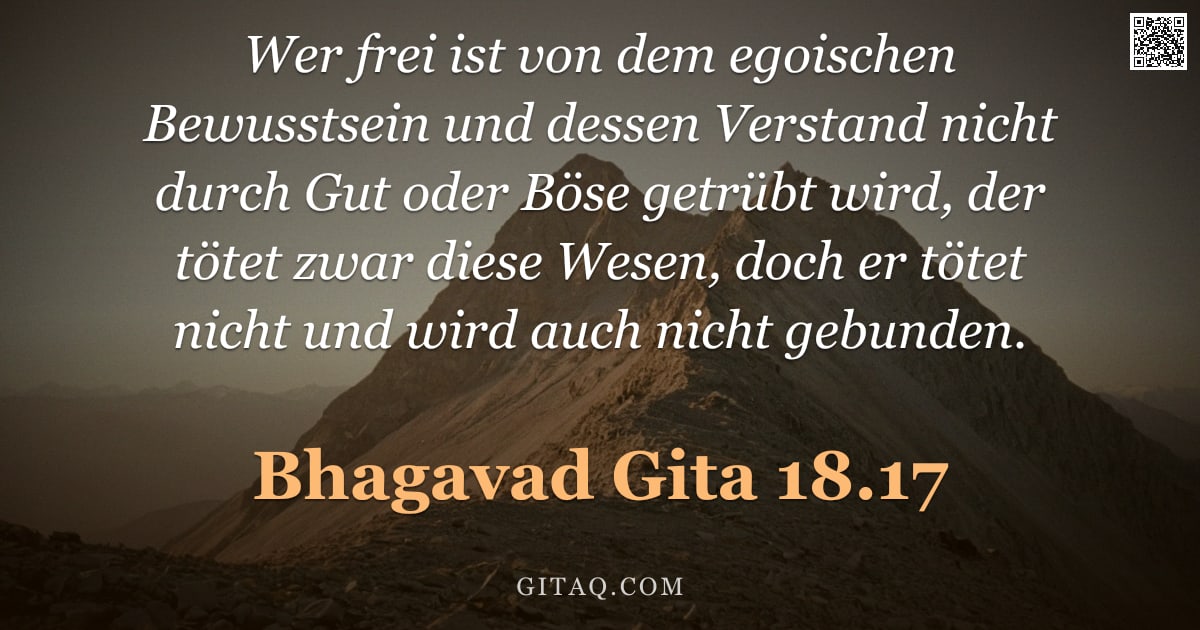
Bhagavad Gita 18.17 — "Wer frei ist von dem egoischen Bewusstsein und dessen Verstand nicht durch Gut oder Böse getrübt wir"
Bhagavad Gita 18.17 — Moksha Sanyasa Yoga
Sanskrit

यस्य नाहंकृतो भावो बुद्धिर्यस्य न लिप्यते | हत्वाऽपि स इमाँल्लोकान्न हन्ति न निबध्यते ||१८-१७||

Transliteration

yasya nāhaṃkṛto bhāvo buddhiryasya na lipyate . hatvā.api sa imā.Nllokānna hanti na nibadhyate ||18-17||

Was bedeutet dieser Vers?

In diesem Vers erklärt Krishna dem Arjuna, dass ein Mensch, der frei von Egoismus ist und dessen Verstand nicht durch das Ergebnis seiner Handlungen gebunden wird, trotz äußerlicher Taten innerlich unversehrt bleibt. Die Kernaussage lautet: Wer im Bewusstsein des höheren Selbst handelt, ohne an den Erfolg oder Misserfolg zu kleben, begeht keine neue Bindung (Karma), auch wenn er physisch tätig ist. Es geht darum, die Handlung auszuführen, aber nicht von der Tat selbst definiert oder belastet zu werden.

Die Lehre dahinter

Dieser Vers gehört primär zur Schule des Karma Yoga, integriert jedoch tiefgreifende Elemente der Jnana (Wissens-) und Sankhya-Philosophie. Er entwickelt das Konzept der 'Nishkama Karma' – Handlung ohne Verlangen nach dem Ergebnis –, indem er zeigt, dass die Befreiung nicht in der Unterlassung von Taten liegt, sondern im Loslassen des Egos während der Tat.

Wort für Wort
यस्य whose, न not, अहंकृतः egoistic, भावः the notion, बुद्धिः intelligence, यस्य of whom, न not, लिप्यते is tainted, हत्वा having slain, अपि even, सः he, इमान् these, लोकान् people, न not, हन्ति slays, न not, निबध्यते is bound
Klassischer Kommentar
I will explain to thee? O Arjuna, the characterisitics of the man who has transcended activity, and who has gone beyond the bonds of Karma. When selfishnes and egoism are destroyed, when desire and personal gain are renounced, actions cannot bind a man. He knows that the Self is not destroyed when the body perishes. He has no idea of agency. The act of killing itself, in his case, becomes one necessary for the peace and harmony of the world. His killing without desire is like the killing of a murderer by the executioner and the judge on behalf of the community for the preservation of peace and harmony in the world. He who has a trained intellect, pure understanding and developed reason, who has a knowledge of the scriptures, who has devoted himself to the study of the scriptures, who is eipped with the knowledge of logic, who is well trained by the instructions of his preceptor, is absolutely free from the egoistic notion that I am the agent or the doer. He knows perfectly well that Nature or Guna or ones own nature does everything. He thus thinks I am the silent witness of all activities. I am not the doer. These five (the body, the actor, etc.) which are superimposed on the pure, actionless Self through ignorance are the causes of all actions. I do not do anything. The senses move amongst the senseobjects. The alities (Gunas) move in their counterparts in the senses which are also the products of the Gunas. I know the essence of the divisions of the alities and their functions. I am in essence without limbs. How can action or work be ascribed to me I am without hands, without legs, without feet, without breath and without mind. I am ever pure, spotless and immovable and immutable. He will never repent thus I have done a wrong action. I ought to have done like this. I have done an evil action. I will go to hell. He is always wise. He can,never do a wrong action. His will has become one with the cosmic will. His will has become blended with the will of the Lord. Whatever he does is done by the Lord only. He has no will of his own. He sees rightly. Though he kills, he does not commit the act of killing. He is not bound by the fruit of a vicious action as an effect of that act. He is beyond good and evil, beyond the pairs of opposites, as he has knowledge of the Self. An objector says The statement that though he kills these people, he does not kill, is selfcontradictory. We say This objection is really not tenable. From the worldly point of view the Lord says though he kills, because man identifies the Self with the body, etc., and thinks I am the killer. From the transcendental point of view explained above, the Lord says? He kills not, he is not bound. Another objector says The Self acts in conjunction with the body, etc.? -- He who looks upon his Self Which is isolated, as the agent৷৷. (XVIII.16)We say This objection also cannot stand. As the omnipresent ether is not affected by reason of its subtlety, even so the Self, seated everywhere in the body, is not affected. This immortal, immutable, changeless, formless, attributeless Self, though seated in the body, does not act and is not affected, just as the crystal is not affected by the red colour of the flower that comes into contact with it, just as the sun is not affected by the diseases of the eye. A thing that changes only can join with others and become the agent. The Self is always isolated, independent and free. This Self is immutable (II.25). The alities move amidst the alities (III.28). Though seated in the body? He does not act (XIII.31). Actions are wrought by the alities (III.27). You will find in the Brihadaranyaka were. By reasoning also we may establish the same conclusion thusThe Self is indivisible, allpervading, infinite, limbless, without parts, independent, ever free and immutable. Therefore the actions of the body can never be ascribed to the agency of the Self. Verily the actions of one cannot go to another who has not done them. Just as blue colour cannot belong to the sky, silver to the motherofpearl, water to mirage, so also what is ascribed to the Self by ignorance cannot really belong to It. The changes that occur in the body pertain to the body but not to the pure actionless Self which is always the spectator or the silent witness. Therefore, it is right to say that the wise man who is free from egoism and all impurities of the mind, neither kills nor is he bound though he kills. In chapter II.19, the Lord stated the proposition -- He slayeth not, nor is he slain. In chapter II.20? He said The Self is unborn, eternal, ancient the Self is not slain when the body is killed. The Lord has touched here and there that the Self is not affected by works, that there is no necessity for the wise man of doing actions. He concludes that the sage kills not, nor is he bound, and sums up the teaching of the Gita. The teaching of the Gita has been concluded in this verse. The Sannyasins who are free from egoism are not affected by Karma. The threefold fruits of action, viz., evil, good and mixed (see verse 12 above) do not accrue to them. Those worldlyminded persons who work with egoism and expectation of fruits are tainted by the works. They are forced to experience the fruits of their actions and to take birth again and again. (Cf. II.19V.7)

Wo dies geschieht

Dieser Vers fällt in das achtzehnte Kapitel des Bhagavad Gita, dem 'Yoga der Befreiung durch Hingabe', gesprochen von Krishna an Arjuna auf dem Schlachtfeld von Kurukshetra. Kurz zuvor hat Krishna die Natur der Handlung (Karma), die Pflicht und den Weg zur Selbstverwirklichung detailliert erläutert, während Arjuna immer noch im Zwiespalt zwischen familiärer Liebe und seiner Kriegerpflicht steht. Der Vers dient als krönender Abschluss zu Kapiteln 16 bis 18, indem er das Geheimnis der Befreiung enthüllt: Die innere Haltung ist entscheidend für die äußeren Taten.

Anwendung für heute

Stellen Sie sich einen Manager vor, der eine schwierige Kündigung aussprechen muss. Wenn er dies aus reinem Egoismus oder Rachsucht tut, fühlt er Schuld und wird psychologisch belastet; wenn er es jedoch als reine Pflicht (Dharma) ohne persönliche Anhaftung an das Ergebnis tut, bleibt sein Geist klar. Er vollzieht die notwendige Handlung mit Respekt und Klarheit, vermeidet aber den inneren Konflikt oder die Bindung an negative Gefühle, weil ihm bewusst ist, dass seine wahre Identität nicht von dieser einen Entscheidung abhängt.

Für Kinder erklärt

Stell dir vor, du spielst ein Videospiel und musst einen Bösewicht besiegen, um weiterzukommen. Wenn du tust, was nötig ist, ohne dabei wütend oder böse zu sein, hast du deinen Job erledigt, aber dein Herz bleibt ruhig. So wie du nach dem Spiel wieder fröhlich spielen kannst, weil es nur ein Spiel war, so kann jemand, der ohne Ego handelt, eine schwere Aufgabe erfüllen, ohne dass sie ihn im Inneren verändert oder belastet.

Tägliche Betrachtung

Liebe:r Suchende:r, heute lade ich dich ein, die Last des eigenen Ichs loszulassen und einfach zu handeln, als wärst du nur das Instrument in den Händen der höheren Kraft. Wenn du diese Tage durchläufst, erinnere daran, dass deine Taten nicht an deinen Erfolg oder Misserfolg gebunden sind, solange dein Verstand rein bleibt. Du bist weder der Täter noch derjenige, der die Konsequenzen tragen muss; du bist jener, der im Fluss des Daseins ruht.

Eine Übung für heute

Schließen Sie für einen Moment die Augen und stellen Sie sich vor, dass Ihr Verstand wie ein klarer Spiegel ist, der keine Furcht oder Hoffnung reflektiert. Atmen Sie tief in das Bewusstsein hinein, dass Ihre Handlungen geschehen mögen, ohne den Kern Ihrer Identität zu berühren.

Kernlehren

  1. Die Auflösung von Ahaṃkāra (Ego)
    Dieser Vers definiert den Zustand eines Weisen durch das Fehlen eines egozentrischen Bewusstseins, bei dem man nicht glaubt, der alleinige Urheber aller Handlungen zu sein. Wer frei vom Ich ist, handelt ohne die Illusion, dass er selbst im Zentrum des Universums steht.
  2. Ungebundenheit durch den reinen Verstand
    Ein Verstand (buddhi), der nicht an Gut oder Böse gebunden wird, bleibt unangetastet von den dualistischen Ergebnissen des Handelns. Selbst wenn physische Taten vollzogen werden, wie das Beenden eines Lebens in einem Kampf, geschieht dies ohne eine spirituelle Bindung oder Schuld.
  3. Die Paradoxie der Handlung
    Das tiefe Geheimnis dieses Verses liegt darin, dass man zwar physisch handelt und sogar 'tötet' (im Kontext des Krieges), aber spirituell weder tötet noch gebunden wird. Dies zeigt den Zustand von Nishkama Karma, bei dem die Handlung vollendet wird, ohne dass das Selbst davon berührt oder verändert wird.

Themen

Egoismus und seine ÜberwindungNishkama Karma (Handlung ohne Anhaftung)Die wahre Natur des SelbstBefreiung von der Bindung an ErgebnisseVerantwortlichkeit vs. SchuldgefühlKlarheit des Verstandes

Verwandte Verse

2.473.304.185.76.5

Lies als Nächstes

  1. 2.47 — Dieser Vers legt das fundamentale Prinzip von Nishkama Karma dar und erklärt direkt, warum man sich nicht an die Früchte der Handlung binden soll.
  2. 3.30 — Hier wird aufgefordert, alle Werke dem Herrn zu übergeben, was eine direkte Anwendung des Loslassens vom eigenen Ich (Ahaṃkāra) ist.
  3. 12.15 — Dieser Vers beschreibt die Eigenschaften eines geliebten Bhaktas und Yogis, der durch seine Gleichmut gegenüber Freude und Leid genau den Zustand erreicht, den in 18.17 beschrieben wird.

Empfohlene Lektüre

GitaQ earns from qualifying purchases as an Amazon Associate.

Diesen Vers teilen

Häufige Fragen

Was bedeutet es, wenn Krishna sagt 'er tötet zwar diese Wesen', aber auch 'nicht'?
Dies ist ein scheinbarer Widerspruch, der die Dualität von physischer und spiritueller Realität auflöst. Physisch vollzieht Arjuna eine Handlung (das Töten in einem symbolischen oder realen Kontext), doch spirituell geschieht kein 'Töten' im Sinne einer Sünde, da das Ego fehlt, das die Tat als eigene Besitzung betrachtet.
Wie kann man wissen, ob der Verstand noch getrübt ist?
Ein getrübter Verstand reagiert emotional auf Erfolg oder Misserfolg und sucht ständiges Bestätigung durch das Ergebnis. Ein ungetrübter Verstand bleibt ruhig und stabil in beiden Fällen, da er die Handlung als Pflicht ausführt, ohne sich mit dem Outcome zu identifizieren.
Ist es möglich, im modernen Alltag so zu leben?
Ja, dies ist das Kernziel des Karma Yoga und für jeden erreichbar. Es bedeutet nicht, untätig zu sein, sondern Aufgaben mit voller Konzentration auszuführen, ohne dabei an den persönlichen Gewinn oder Verlust emotional festzuhaken.
Warum wird man sonst 'gebunden'?
Man wird gebunden durch das Ego (Ahamkara), das die Handlung als 'mein Werk' betrachtet und somit Ansprüche auf den Erfolg oder Angst vor dem Misserfolg entwickelt. Diese Anhaftung erzeugt neue Karmaspuren, die einen im Kreislauf der Wiedergeburt festhalten.
In anderen Sprachen: Bhagavad Gita 18.17 →