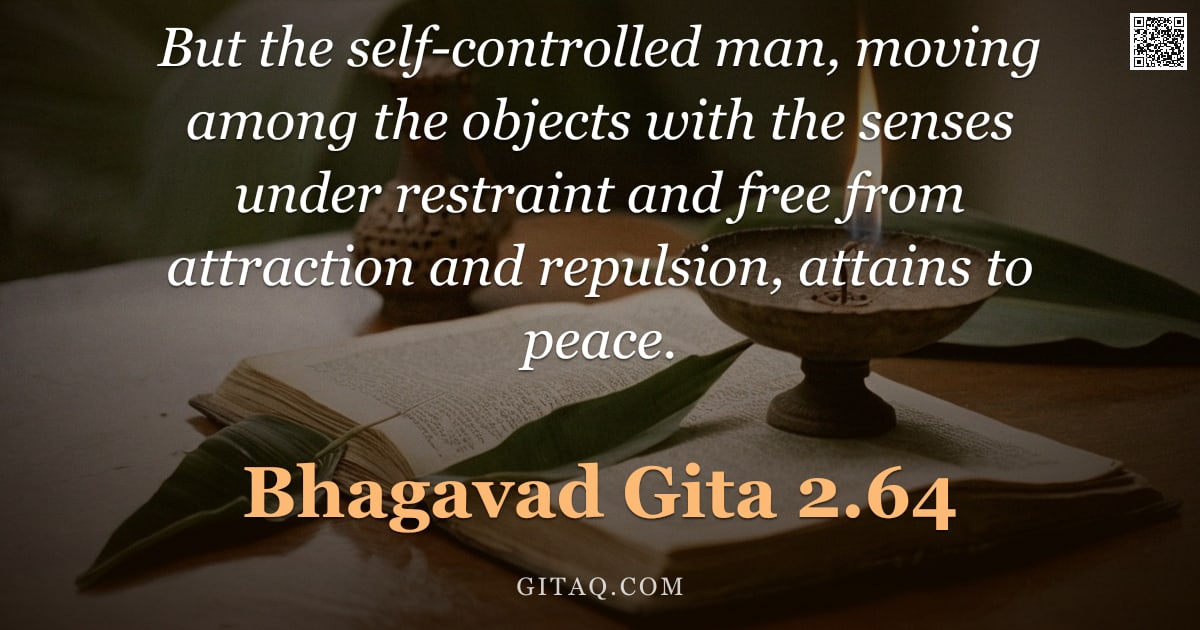
Bhagavad Gita 2.64
Sankhya Yoga · English Translation
रागद्वेषविमुक्तैस्तु विषयानिन्द्रियैश्चरन् | (or वियुक्तैस्तु) आत्मवश्यैर्विधेयात्मा प्रसादमधिगच्छति ||२-६४||
rāgadveṣavimuktaistu viṣayānindriyaiścaran . orviyuktaistu ātmavaśyairvidheyātmā prasādamadhigacchati ||2-64||
What Does This Verse Mean?
Lord Krishna is teaching Arjuna that true peace comes from mastering one's senses rather than avoiding the world entirely. He explains that a person who moves among sensory objects without being pulled by attraction or pushed away by repulsion, while keeping their mind under control, will naturally attain deep inner tranquility. This verse emphasizes that freedom from extreme emotional reactions to pleasure and pain is the key to spiritual stability.
The Teaching Behind It
This verse is a cornerstone of Karma Yoga, specifically detailing the mental discipline required for selfless action. It develops the concept of 'Indriya Nigraha' (restraint of senses) and introduces the state of 'Sthita-prajna', where one remains steady in wisdom despite external sensory inputs.
Word by Word
Classical Commentary
Where This Happens
This verse appears in Chapter 2 during the dialogue between Lord Krishna and Arjuna on the battlefield of Kurukshetra. Just moments before this teaching, Arjuna has collapsed into a state of despair, refusing to fight his own relatives due to overwhelming attachment and fear. Krishna is shifting from explaining the eternal nature of the soul to practical instructions on how an enlightened person should interact with the world while remaining steady in their duty.
Living It Out Today
Consider a professional facing a sudden, high-stakes negotiation where they might be offered a huge bonus or insulted severely by the other party. Instead of reacting impulsively out of greed for the money (attraction) or anger at the insults (repulsion), this person pauses to observe their emotions without acting on them immediately. By maintaining equanimity and focusing solely on the truth of the situation, they make a clear-headed decision that leads to a better outcome than if they had been ruled by fleeting passions.
Explained for Children
Imagine you are walking through a candy shop filled with delicious treats, but you don't feel like you *must* eat every single piece of candy or run away if there's something boring. If you can just look at the candies, taste one if you want, and leave without getting too excited or sad about what is on the shelf, your heart stays calm and happy inside. That kind of self-control helps you feel peaceful no matter where you are.
Daily Reflection
Today, when you encounter something you love intensely or dislike deeply, pause to see if your peace is being held hostage by that object. Remember that true freedom isn't about avoiding the world, but moving through it with senses under control, untouched by the waves of attraction and repulsion. In those moments of restraint, you will find a quiet joy that no external circumstance can disturb.
A Practice for Today
Sit quietly and imagine your senses encountering an object of desire or aversion, yet observing them as a silent witness rather than participating in the reaction. Visualize yourself stepping back into that inner stillness where attraction and repulsion dissolve, leaving only pure awareness.
Key Teachings
- The Power of Detached Engagement
Krishna teaches that spiritual progress happens not by fleeing the world, but by engaging with it while remaining free from attachment and aversion. The seeker moves among sense objects without being pulled toward them or pushed away by fear. - Sensory Restraint as a Catalyst
The verse emphasizes that the senses must be under strict control, yet this restraint is not forced suppression but natural mastery. When actions are performed with self-control, they become instruments of peace rather than sources of agitation. - Divine Grace as the Result
The ultimate fruit of living free from duality and mastering one's senses is 'prasadam,' or divine grace. This state represents a profound inner tranquility that arises spontaneously when the mind is no longer disturbed by dualities.
Themes
Related Verses
Read This Next
- 2.47 — This verse establishes your right to action without attachment to results, which is the foundation for practicing detachment in daily life.
- 3.30 — Here Krishna instructs on offering all actions to Him, a practical method for maintaining inner peace while actively engaging with sense objects.
- 12.15 — This verse describes the qualities of one who is dear to God and has transcended duality, directly reflecting the state of 'prasadam' mentioned in this chapter.
Recommended Reading
GitaQ earns from qualifying purchases as an Amazon Associate.