Bhagavad Gita 15.1

Purushottama Yoga · Deutsche Übersetzung
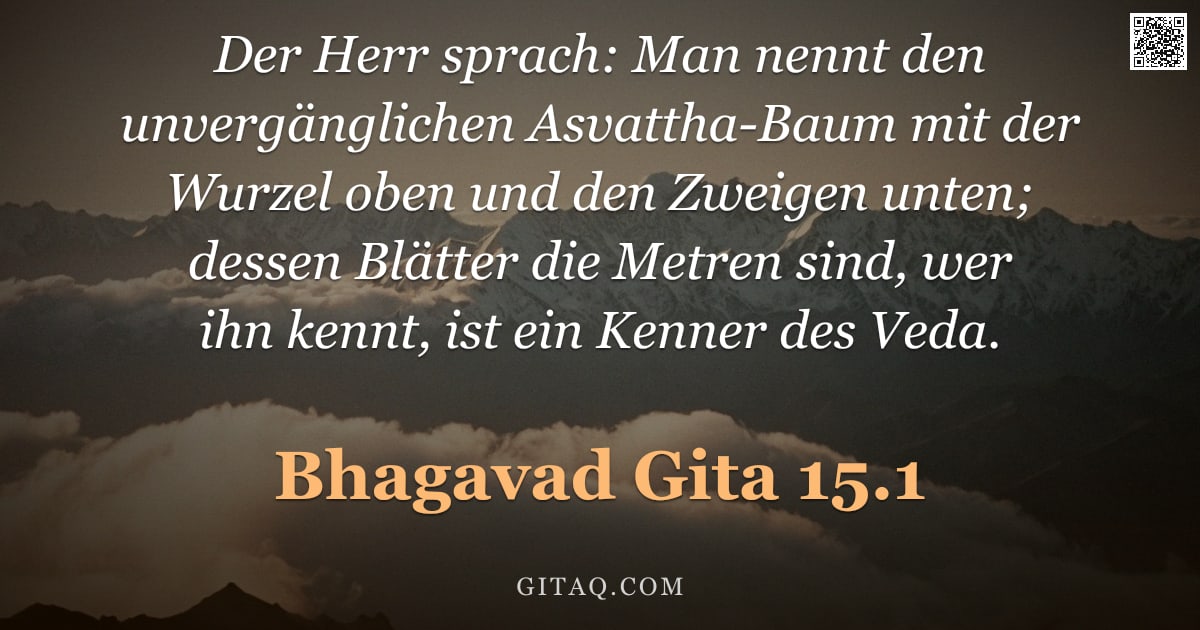
Bhagavad Gita 15.1 — "Der Herr sprach: Man nennt den unvergänglichen Asvattha-Baum mit der Wurzel oben und den Zweigen unt"
Bhagavad Gita 15.1 — Purushottama Yoga
Sanskrit

श्रीभगवानुवाच | ऊर्ध्वमूलमधःशाखमश्वत्थं प्राहुरव्ययम् | छन्दांसि यस्य पर्णानि यस्तं वेद स वेदवित् ||१५-१||

Transliteration

śrībhagavānuvāca . ūrdhvamūlamadhaḥśākhamaśvatthaṃ prāhuravyayam . chandāṃsi yasya parṇāni yastaṃ veda sa vedavit ||15-1||

Was bedeutet dieser Vers?

In diesem Vers spricht Krishna zu Arjuna und beschreibt die materielle Welt als einen unvergänglichen Feigenbaum (Asvattha). Die Besonderheit dieses Baumes ist, dass seine Wurzel im Himmel bei Brahman liegt, während seine Zweige nach unten in die materielle Existenz wachsen. Wer diese symbolische Struktur versteht, wer also erkennt, woher das Leben kommt und wohin es zurückkehrt, gilt als wahrer Kenner der heiligen Schriften (Vedas). Dies ist eine Einladung, den Blick von den vergänglichen Ästen des materiellen Lebens auf die ewige Wurzel zu richten.

Die Lehre dahinter

Dieser Vers ist ein Kernstück des Jnana Yoga (Weg des Wissens), da er die wahre Natur der Realität durch eine symbolische Analyse offenbart. Er entwickelt das Konzept von Maya, indem er zeigt, wie sich die ewige spirituelle Wahrheit in der vergänglichen materiellen Welt spiegelt und verstrickt. Es verbindet Sankhya-Philosophie mit Vedanta, um zu lehren, dass Befreiung (Moksha) nur durch das Erkennen dieser invertierten Struktur möglich ist.

Wort für Wort
ऊर्ध्वमूलम् rooted above, अधःशाखम् branches below, अश्वत्थम् the Asvattha, प्राहुः they speak of, अव्ययम् indestructible, छन्दांसि metres or hymns, यस्य of which, पर्णानि leaves, यः who, तम् that, वेद knows, सः he, वेदवित् is the knower of the Vedas
Klassischer Kommentar
The description of the universe as a peepul tree is only metaphorical. This peepul is said to be eternal because it cannot be cut except by the axe of knowledge. All persons depend upon the Lord for the fruits of their actions, because He alone knows the right relation between the actions and their fruits. He alone is the dispenser of the fruits of actions of human beings. The wise persons also depend upon the Lord for the fruit of their knowledge. The Lord alone removes the veil of ignorance through His grace and mercy. The inclination for Advaita Vedantic Sadhana arises through the Lords grace. The desire for the realisation of the Oneness is produced in the minds of wise men by the grace of the Lord, which is the antidote to all fears. (Avadhuta Gita? I.1)Those who serve the Lord with unswerving or singleminded devotion go beyond the three alities of Nature through His grace. They attain knowledge of the Self through the grace of the Lord and get release from the round of birth and death. Those who have a right understanding of the real nature of Brahman or the Supreme Being also get emancipation easily. The Lord teaches Arjuna in this discourse about the real nature of Brahman or the Supreme Self and the path that leads the soul to union with Him. The Lord describes the nature of Samsara or worldly life as a peepul tree in order to create nonattachment or dispassion, because he who is endowed with true and lasting dispassion alone is fit for attaining the knowledge of the Self. Samsara is compared to a tree. because it can be cut off like a tree. All the other trees have their roots below, but this peculiar, strange and most wonderful tree of Samsara (Maya) has its root above, in Brahman. This peepul tree is different from all other trees. Brahman is the resting place or support of everything. It is eternal. It is great. It is the most high. It is the Supreme Being. It is supreme over all things. It is the source of everything. Therefore it is said that It is the One above. This One above is the root of this tree of Samsara. Brahan Who is superior to all is Urdhva. That which has Brahman as its cause is Urdhvamulam. In the Puranas it is said The tree of the Unmanifest has sprung from Brahman. Buddhi is its trunk, the senseopenings are its hollows, the great elements its boughs, the senseobjects its leaves and branches? Dharma and Adhrama (virtue and vice) its beautiful flowers, pleasure and pain its fruits. Having cut asunder this tree with the powerful sword of the knowledge of the Self, and then having attained to the eternal bliss of Brahman, no one comes back from there again. Brahman is the root of this tree. It is the upper part of this tree and so It is called Urdhva. In reality there are no distinctions such as upward, downward or middle in the One Which is the indivisible unity. The name Asvattha is usually derived from Asvattha which means not standing or enduring or remaining till tomorrow. A means not Sva means tomorrow Ttha means remaining. This is ite an appropriate word for this worldtree which is ever changing and passing away. In the Katha Upanishad also there is a mention about this Asvattha tree (II.6.1). The Gita is an essence of the Upanishads only. Samsara is generally understood by the common people as meaning remaining surrounded by ones wife and children and doing ones daily duties. This is a restricted or narrow meaning. Samsara means the whole worldprocess or the cosmic manifestation or the everchanging phenomenal world. Hiranyagarbha, the individual souls, the cosmic intelligence, egoism, the rootelements, etc., represent the brancehs of this tree of Samsara. They extend downwards. They evolve into grosser and grosser states. Therefore it is said that the tree has its branches below. Egoism is the sprout which goes downwards in three directions, viz., the three alities of Nature. Mind is the offshoot. Then come the five elements, viz., earth, water, fire, air and ether, and the five organs of knowledge. Then comes sound which stimulates the ears to hear sweet music. Then comes touch which stimulates the skin to enjoy soft things. Then comes form which stimultaes the eye to behold beautiful objects. Then comes taste which stimulates the tongue to enjoy palatable things. Then comes smell which stimulates the nose to enjoy fragrant and scented objects. From the roots of actions with expectation of fruits a new branch of rirth comes up. The mineral kingdom, the vegetable kingdom, the animal kingdom and the human kingdom are all branches of this tree of Samsara. Man does good and evil actions with the help of the body and takes births to experience the fruits thereof. The human body is the water for this tree of Samsara. The body itself is the peepul tree. The root is the cerrospinal nervous system (brain). The various nerves are the branches that ramify downwards to the various organs distributed over the body. Avyaya Eternal, because this tree rests on an unbroken seires of births without beginning and end it is thus eternal. It can be cut down by the sword of knowledge of Brahman. Just as the leaves of a tree protect it, so also the Vedas protect this tree of Samsara, treating of virtue and vice, with their causes and fruits. He who knows this tree of Samsara and its roots as described above is a knower of the Vedas. He is a knower of the teachings of the Vedas. Not even an iota remains to be known beyond this tree of Samsara and its root. He who knows it is omniscient. The Lord has eulogised the knowledge of the tree of Samsara and its root in order to encourage aspirants to acire this knowledge.

Wo dies geschieht

Dieser Vers findet sich in Kapitel 15 der Bhagavad Gita während des Krieges auf dem Schlachtfeld von Kurukshetra. Krishna hat gerade Arjuna erklärt, dass die materielle Welt voller Leid ist und wie ein Baum aus Wurzeln besteht, an denen man nicht hängen sollte. Er wendet sich nun direkt an Arjuna, der noch immer im Zweifel über seine Pflicht als Krieger gefangen zu sein scheint, um ihm eine tiefe philosophische Vision zu geben. Durch diese Metapher soll Arjunas Verstand von der Illusion des Materiellen befreit werden.

Anwendung für heute

Stell dir vor, du stehst unter großem Druck bei der Arbeit und fühlst dich überlastet durch E-Mails, Deadlines und den Stress im Haushalt. Statt wie ein Kind an den Ästen dieses Baumes zu hängen – also in endloser Sorge um das Vergängliche gefangen zu sein –, kannst du die Perspektive wechseln. Du fragst dich: Was ist meine innere Wurzel? Indem du deine Handlungen als Dienstleistung (Seva) oder als Ausdruck deiner höheren Werte siehst, löst sich der Stress vom reinen Egoismus. So behältst du in schwierigen Entscheidungen Ruhe und Klarheit.

Für Kinder erklärt

Stell dir einen riesigen Baum vor, aber er wächst nicht normal. Seine Wurzeln hängen im Himmel und seine Zweige wachsen nach unten in unsere Welt hinein. Die Blätter dieses Baumes sind wie kleine Liedchen aus den alten Geschichten (die Vedas). Krishna erklärt uns damit, dass unser Leben hier auf der Erde nur ein kleiner Teil von etwas viel Größerem ist. Wenn du verstehst, woher dieser Baum wirklich kommt und was seine Wurzeln bedeuten, dann kennst du das Geheimnis des Lebens richtig gut.

Tägliche Betrachtung

Vielleicht fühlst du dich heute so wie einer der Zweige dieses Baumes: verwickelt in den ständigen Wechsel von Freude und Leid. Doch erinnere dich daran, dass deine wahre Identität nicht an diesen Blättern haftet, sondern tief verwurzelt ist im Unvergänglichen, das jenseits des Raums liegt. Wenn du heute die Sinne beruhigst, beginnst du zu erkennen, wer du wirklich bist – ein ewiges Wesen, das von der Quelle alles Lebens gespeist wird.

Eine Übung für heute

Stellen Sie sich vor, wie die Wurzel eines gewaltigen Eibenbaums (Asvattha) im Unvergänglichen verborgen ist und ihre Zweige in unsere materielle Welt hinunterreichen. Lassen Sie Ihren Geist von den vergänglichen Blättern der Sinne absteigen und zu dieser einen Quelle des Lebens emporwachsen, die jenseits aller Veränderung ruht.

Kernlehren

  1. Die Wurzel im Höchsten
    Der Baum des Daseins hat seine Basis nicht in dieser Welt, sondern in Brahman selbst. Dies bedeutet, dass alle materielle Existenz von einer transzendenten Realität abhängt und ohne diese keine Stabilität finden kann.
  2. Die Vergänglichkeit der Blätter
    Die Veden werden als die Blätter dieses Baumes beschrieben, was zeigt, dass selbst heilige Wissenstraditionen in diesem Zyklus des Entstehens und Vergehens ihre Funktion erfüllen. Wer den Baum nicht durchschaut, bleibt an diesen vergänglichen Formen haften.
  3. Das wahre Erkennen
    Nur derjenige, der die Natur dieses Baumes erkennt – seine Wurzel oben und die Zweige unten –, wird als wahrer Kenner des Veda bezeichnet. Dieses Wissen führt zur Befreiung von der Bindung an das materielle Dasein.

Themen

Die Natur der Welt als IllusionDas Konzept des Asvattha-BaumsVerbindungen zwischen Himmel und ErdeWahrheit der Vedas verstehenLoslassen von AnhaftungDer Weg zur Befreiung

Verwandte Verse

2.473.304.186.518.66

Lies als Nächstes

  1. 2.47 — Dieser Vers erklärt die Praxis des selbstlosen Handelns (Nishkama Karma), was notwendig ist, um sich von den Zweigen dieses Baumes zu lösen.
  2. 18.64 — Der letzte Vers gibt den abschließenden Rat, Krishna ganz zu umarmen, der das Ende aller Bindungen an diesen materiellen Zyklus darstellt.

Empfohlene Lektüre

GitaQ earns from qualifying purchases as an Amazon Associate.

Diesen Vers teilen

Häufige Fragen

Was symbolisiert der Asvattha-Baum genau?
Der Asvattha-Baum ist eine Metapher für die materielle Welt (Samsara). Er repräsentiert das Leben, das aus dem Echten entsteht und in Vergänglichkeit verwurzelt ist. Die Wurzel oben zeigt auf Brahman als Quelle allen Seins.
Wer sind die Blätter des Baumes?
Die Blätter dieses mystischen Baumes sind die Metren (Chandas) der Veden, also die heiligen Lieder und hymnische Strophen. Sie symbolisieren das Wissen über Gott und die Welt, das für diejenigen zugänglich ist, die den Baum richtig verstehen.
Warum wird diese Wurzel als 'unvergänglich' bezeichnet?
Obwohl der Baum selbst in der materiellen Welt existiert, wird seine Essenz oder sein Ursprung (die Wurzel bei Brahman) als unvergänglich beschrieben. Das bedeutet, dass die spirituelle Quelle und das Bewusstsein dahinter ewig ist, auch wenn sich die Blätter im Zyklus von Geburt und Tod verändern.
Wie hilft dieses Wissen einem Menschen zur Befreiung?
Wer diesen Baum kennt, versteht, dass er nicht an den vergänglichen Zweigen (materiellen Ergebnissen) hängen darf. Dieses Verständnis führt zu Loslösung und ermöglicht es dem Suchenden, durch das Erkennen der Wurzel wieder in die Einheit mit Brahman zurückzukehren.
In anderen Sprachen: Bhagavad Gita 15.1 →