薄伽梵歌 15.7

Purushottama Yoga · 中文翻译
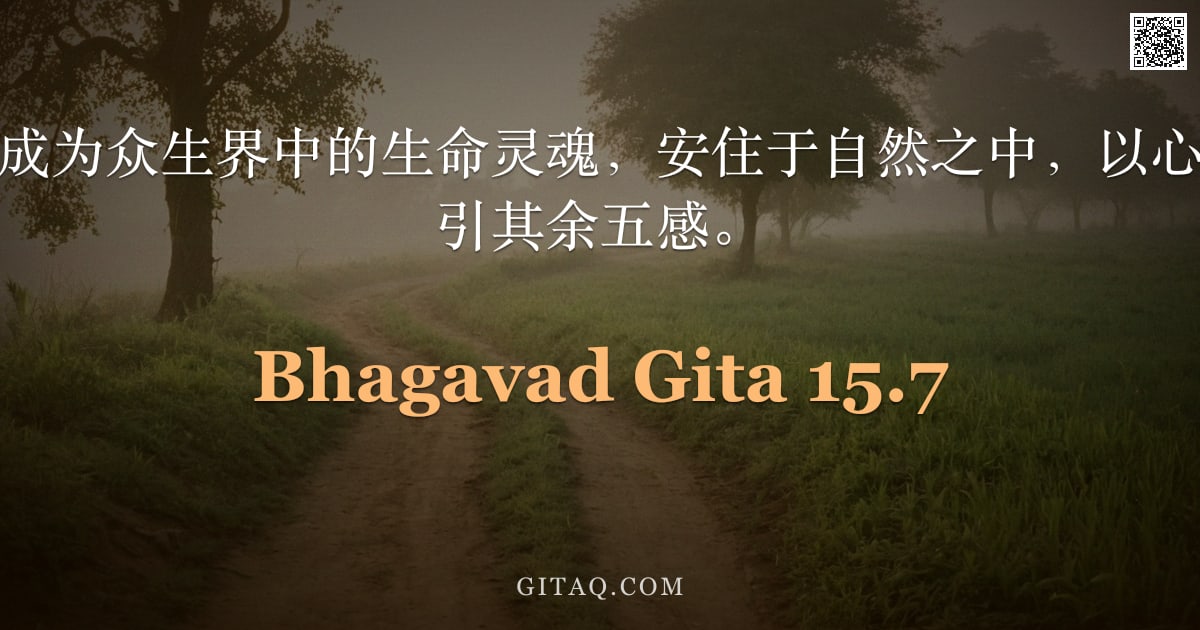
薄伽梵歌 15.7 — "我永恒的一部分成为众生界中的生命灵魂,安住于自然之中,以心为第六感官,牵引其余五感。"
薄伽梵歌 15.7 — Purushottama Yoga
梵文

ममैवांशो जीवलोके जीवभूतः सनातनः | मनःषष्ठानीन्द्रियाणि प्रकृतिस्थानि कर्षति ||१५-७||

转写

mamaivāṃśo jīvaloke jīvabhūtaḥ sanātanaḥ . manaḥṣaṣṭhānīndriyāṇi prakṛtisthāni karṣati ||15-7||

这节经文是什么意思?

在《博伽梵歌》第15章中,克里希纳向阿周那揭示了一个深刻的真理:每一个生命灵魂都是至尊主永恒的一部分。这些永恒的个体虽然被包裹在物质自然之中,但本质上是神圣的。克里希纳指出,心(mind)是第六种感官,它牵引着其余五种感官去感知世界并体验生活。这一教导旨在让阿周那明白生命的本质并非仅仅是物质的躯壳,而是拥有永恒灵魂的存在。

背后的教义

这一教导属于吠檀多哲学中关于个体灵魂(Jiva)与终极实在(Brahman/Krishna)关系的阐述,同时也融合了数论派(Sankhya)对物质自然(Prakriti)和感官运作的分析。它深化了“梵我一如”但个体性并存的概念,解释了为何永恒的灵魂会陷入物质束缚以及心在其中的核心作用。

逐字释义
मम My, एव even, अंशः portion, जीवलोके in the world of life, जीवभूतः having become a soul, सनातनः eternal, मनःषष्ठानि with mind as the sixth, इन्द्रियाणि the (five) Indriyas, प्रकृतिस्थानि abiding in Prakriti, कर्षति draws (to itself)
古典注释
Now the Lord explains how the individual soul comes into being. The individual soul is a ray of the Lord. A ray of the Supreme Being enters Nature, draws to itself the five senses and the mind and becomes an embodied soul (Jiva) by assuming a body. Here is a description of how the subtle body or LingaSariria enters the gross body. Although the sun is reflected in water, it is not in any way tainted. When a crystal comes in,contact with a red cloth or red flower, it seems to be red but it is really not so. Even so the Supreme Beings is not in any way tainted by the actions of the individual soul. Ignorance is the limiting adjunct of the individual soul. On account of the limitation caused by this ignorance the soul experiences that it is the doer and the enjoyer. In essence the individual soul is identical with the Supreme Being or Brahman. When ignorance, the limiting adjunct or principle, is destroyed, the individual soul (Jiva) realises it identity with the Supreme Being (Brahman).Just as the ether in the pot becomes one with the universal ether when the limiting adjunct, the pot, is broken, so also the individual soul becomes one with Brahman when the limiting adjunct, ignorance, is annihilated. Just as there is no return of the potether after it has become one with the universal ether when the pot is destroyed, so also there is no return of the individual soul after the limiting adjunct (the Antahkarana, i.e., mind and the other inner instruments) is destroyed. It becomes one with Brahman. Pratibimba (reflection) is only a portion of the Bimba (object). The reflected sun is only a portion of the real sun (the rays of the sun). When the water is removed the reflected sun goes back to the original sun, as it were. It does not return to the water again. Even so, when ignorance or the mind is annihilated, the Jiva (individual soul) which is a reflection of Brahman in ignorance is absorbed in the Bimba Brahman. It does not return to this world of birth and death. The individual soul is only an imaginary or fictitious portion of Brahman. It is not a real portion. For the Supreme Being is indivisible. It has no parts. If It has parts? It would be liable to destruction when the parts are disjointed or removed. The senses abide in Nature, in their respective seats such as ear, skin, tongue, eye and nose. A Sannyasi living in the caves of the Himalayas dreams that he is a married man and moves about hither and thither to get a job for his livelihood. Even so, the individual soul forgets its real divine nature, mistakes the impure, perishable body for the pure, immortal Self and imagines that it is the real actor and enjoyer by identifying itself with the body. It says? I am the Karta. I am the Bhokta. I am a soul bound by Samsara. I am happy. I am miserable. It becomes finite. In essence the Jiva is identical with Brahman. The difference is on account of delusion or imagination or superimposition. The illusion of difference is due to the limiting adjunct or principle (the mind) even as the illusion that the ether in the pot is different from the universal ether is caused by the limiting adjunct, viz., the pot. Jivabrahmabhedabhranti (the delusion of the distinctior between the individual soul and the Supreme Being) is removed when the limiting adjunct (mind) is annihilated. In deep sleep the mind rests in a subtle state along with all the Samskaras (impressions) and Vasanas (tendencies) in its cause (primordial ignorance). Again it comes back from this state of ignorance when you return to the waking state. If the cause (ignorance) is destroyed by the knowledge of the Self, its effect (mind) is also annihilated. Just as the tortoise stretches out its head and feet which were in a state of Laya (absorption) in its body, so also the individual soul strecthces out its mind and senses which were in a state of absorption in primordial ignorance in deep sleep, to enjoy the sensual objects in the waking state. A ray of the Supreme Being enters Nature, draws to itself the five senses and the mind In this verse the formation of the astral body (LingaSarira or Sukshmasarira) is described. The Sruti declaresस एष इह प्रविष्टः आनखाग्रेभ्यः तत् सृष्ट्वा तदेवानुप्राविशत्।।That Supreme Being Itself, having created this aggregate of the body from the head to the toe, entered this body in the form of the Jiva. According to Vedanta there are nineteen principles, viz., the five organs of knowledge, the five organs of action, the five vital airs (Prana? Apana? Vyana? Samana and Udana), the mind, intellect? Chitta (the subconscious or the unconscious mind), and egoism. We will have to conclude that the words the five senses and the mind point to the collection of the remaining thirteen principles also. Amsa This does not mean here a particle or portion which has been cut out. It is like the Amsar of the ether in the pot the ether is not cut out but still remains the whole ether. (Cf. XIV.3)

发生在何处

这段经文出自《博伽梵歌》第15章“至上人格瑜伽”,发生在俱卢之野大战即将开始的紧张时刻。此时,阿周那因对亲人产生强烈的怜悯而陷入绝望,拒绝战斗并放下武器。作为神圣的导师,克里希纳在解释了灵魂不朽和物质自然的本质后,进一步揭示个体灵魂与至尊主的关系,以消除阿周那关于生命本质的困惑。

今日应用

当你在职场中面临巨大的焦虑或道德困境时,试着将注意力从外在的压力转移到内在的核心——那个永恒的观察者(真我)。不要让自己被感官的冲动所驱使,比如逃避困难或被短期的利益诱惑;相反,要运用“心”作为第六感来保持清醒和专注。通过意识到自己拥有超越物质环境的永恒本质,你能够以更平静、更坚定的态度去处理复杂的决策和生活挑战。

儿童解释

想象一下,太阳的光芒和每一个小水滴里的光都是来自同一个太阳的。克里希纳告诉我们,你和我里面的“真我”就像这些光芒一样,是神圣且永恒的,永远都不会消失。虽然我们的身体像是一辆暂时的车,但住在这辆车里的灵魂是来自天上的永恒火花。我们的心就像是这车的方向盘,它指挥着眼睛、耳朵等五个感官去探索这个世界和体验生活。

每日省思

亲爱的朋友,你是否曾感到自己只是被感官牵引着盲目行动?请记得,在这纷繁的自然(Prakriti)运作背后,住着一个永恒的灵魂,它是我神圣光辉的一小部分。你的心是第六感,也是统御其他五感的君王;当你学会以内在的觉知去引导而非压抑欲望时,你便是在回归那本有的自由与宁静。

今日的修习

请安坐,将注意力从外在感官收摄回内在的心。观想那永恒的生命灵魂(Jiva)正安住于你的心中,它虽身处物质世界,却源自神圣的光明。在静默中感受这份来自克里希纳的脉动,明白你并非这具身体或思绪的奴隶。

核心教导

  1. 永恒的灵魂本质 (Sanatana)
    每一个生命体中的灵魂都是克里希纳神圣光辉的永恒片段(Mamaivamsa),从未被创造也永不消亡,它是超越物质生灭循环的真实存在。
  2. 身心的统御机制 (Manas)
    心(Mind)在感官运作中扮演着第六感及指挥官的角色;它既可能将灵魂拉入物质的束缚与痛苦,也能引导五感走向觉醒与解脱。
  3. 物质中的神圣临在
    尽管灵魂安住于自然(Prakriti)之中并经历感官的牵引,但其本质始终未被污染;认识到这种内在的神圣性是实现自我认知的关键第一步。

主题

灵魂的本质 (Nature of the Soul)心与感官 (Mind and Senses)永恒性 (Eternity)物质自然 (Material Nature)个体自我 (Individual Self)克里希纳的教导 (Krishna's Teaching)

相关经文

2.473.304.1818.666.5

接下来阅读

  1. 2.47 — 此节教导如何在行动而不执着结果中行使正法(Dharma),是理解灵魂如何驾驭感官活动的实践基础。
  2. 3.30 — 通过将所有行为奉献给克里希纳,我们可以净化心意,从而更好地掌控那作为第六感的心智。
  3. 12.15 — 此节描述了解脱者的特质——不扰动众生也不被众生所扰,这正是灵魂安住于神圣本性后的自然状态。

推荐阅读

GitaQ earns from qualifying purchases as an Amazon Associate.

分享这节经文

常见问题

克里希纳与阿周那关于灵魂的对话属于哪种瑜伽?
这段经文主要阐述了智慧瑜伽(Jnana Yoga)的核心教义,即通过分辨真我与假我、永恒与非永恒的真理来获得解脱。同时,它也涉及数论派哲学对物质自然和个体灵魂关系的分析,为后续的业报瑜伽和奉爱瑜伽奠定了基础。
其他语言: 薄伽梵歌 15.7 →