薄伽梵歌 15.1

Purushottama Yoga · 中文翻译
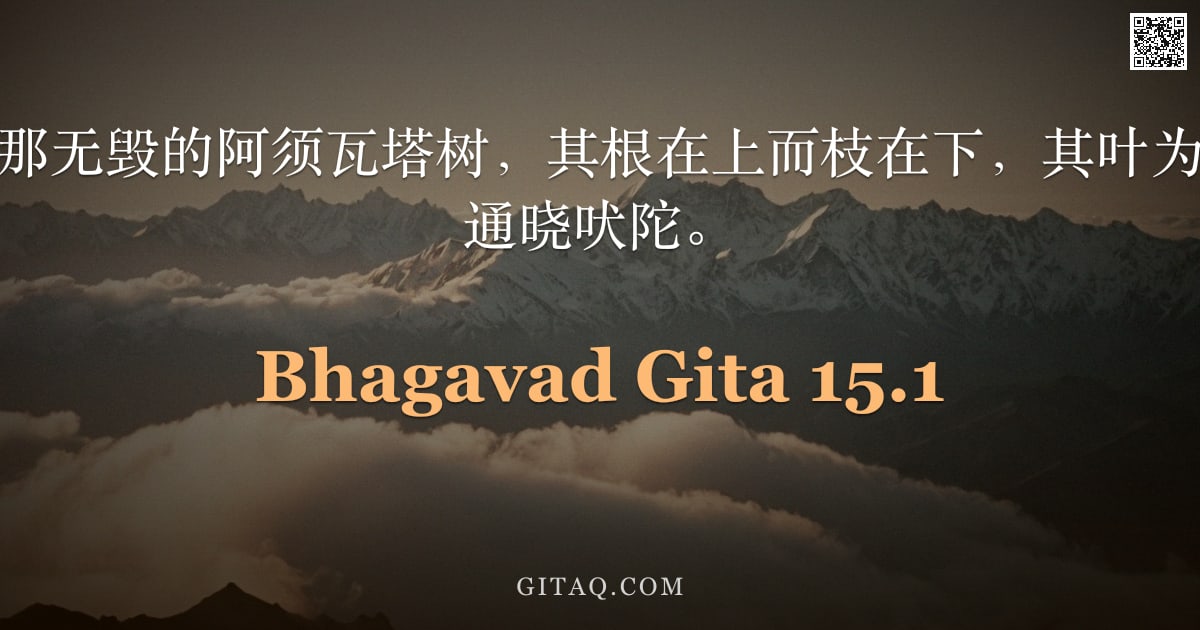
薄伽梵歌 15.1 — "圣主说:他们称那无毁的阿须瓦塔树,其根在上而枝在下,其叶为颂诗;知此者即通晓吠陀。"
薄伽梵歌 15.1 — Purushottama Yoga
梵文

श्रीभगवानुवाच | ऊर्ध्वमूलमधःशाखमश्वत्थं प्राहुरव्ययम् | छन्दांसि यस्य पर्णानि यस्तं वेद स वेदवित् ||१५-१||

转写

śrībhagavānuvāca . ūrdhvamūlamadhaḥśākhamaśvatthaṃ prāhuravyayam . chandāṃsi yasya parṇāni yastaṃ veda sa vedavit ||15-1||

这节经文是什么意思?

在这节经文中,圣主克里希那向阿朱纳揭示了一个关于宇宙本质的深刻比喻:这棵“无毁的阿须瓦塔树”(神圣菩提树)根在上、枝在下。它的叶子是《吠陀》颂诗,意味着所有的知识都蕴含其中。克里希那教导说,只有真正理解并参透这棵树象征意义的人,才算得上是通晓真理的智者,从而超越物质的束缚。

背后的教义

这节经文属于智慧瑜伽(Jnana Yoga)与数论哲学(Sankhya)的核心教导,旨在通过分辨“永恒”与“短暂”来确立真正的知识。它阐述了物质世界(Prakriti)是灵性本体(Brahman/Purushottama)的倒影这一概念,强调唯有透过现象看本质才能证悟真理。

逐字释义
ऊर्ध्वमूलम् rooted above, अधःशाखम् branches below, अश्वत्थम् the Asvattha, प्राहुः they speak of, अव्ययम् indestructible, छन्दांसि metres or hymns, यस्य of which, पर्णानि leaves, यः who, तम् that, वेद knows, सः he, वेदवित् is the knower of the Vedas
古典注释
The description of the universe as a peepul tree is only metaphorical. This peepul is said to be eternal because it cannot be cut except by the axe of knowledge. All persons depend upon the Lord for the fruits of their actions, because He alone knows the right relation between the actions and their fruits. He alone is the dispenser of the fruits of actions of human beings. The wise persons also depend upon the Lord for the fruit of their knowledge. The Lord alone removes the veil of ignorance through His grace and mercy. The inclination for Advaita Vedantic Sadhana arises through the Lords grace. The desire for the realisation of the Oneness is produced in the minds of wise men by the grace of the Lord, which is the antidote to all fears. (Avadhuta Gita? I.1)Those who serve the Lord with unswerving or singleminded devotion go beyond the three alities of Nature through His grace. They attain knowledge of the Self through the grace of the Lord and get release from the round of birth and death. Those who have a right understanding of the real nature of Brahman or the Supreme Being also get emancipation easily. The Lord teaches Arjuna in this discourse about the real nature of Brahman or the Supreme Self and the path that leads the soul to union with Him. The Lord describes the nature of Samsara or worldly life as a peepul tree in order to create nonattachment or dispassion, because he who is endowed with true and lasting dispassion alone is fit for attaining the knowledge of the Self. Samsara is compared to a tree. because it can be cut off like a tree. All the other trees have their roots below, but this peculiar, strange and most wonderful tree of Samsara (Maya) has its root above, in Brahman. This peepul tree is different from all other trees. Brahman is the resting place or support of everything. It is eternal. It is great. It is the most high. It is the Supreme Being. It is supreme over all things. It is the source of everything. Therefore it is said that It is the One above. This One above is the root of this tree of Samsara. Brahan Who is superior to all is Urdhva. That which has Brahman as its cause is Urdhvamulam. In the Puranas it is said The tree of the Unmanifest has sprung from Brahman. Buddhi is its trunk, the senseopenings are its hollows, the great elements its boughs, the senseobjects its leaves and branches? Dharma and Adhrama (virtue and vice) its beautiful flowers, pleasure and pain its fruits. Having cut asunder this tree with the powerful sword of the knowledge of the Self, and then having attained to the eternal bliss of Brahman, no one comes back from there again. Brahman is the root of this tree. It is the upper part of this tree and so It is called Urdhva. In reality there are no distinctions such as upward, downward or middle in the One Which is the indivisible unity. The name Asvattha is usually derived from Asvattha which means not standing or enduring or remaining till tomorrow. A means not Sva means tomorrow Ttha means remaining. This is ite an appropriate word for this worldtree which is ever changing and passing away. In the Katha Upanishad also there is a mention about this Asvattha tree (II.6.1). The Gita is an essence of the Upanishads only. Samsara is generally understood by the common people as meaning remaining surrounded by ones wife and children and doing ones daily duties. This is a restricted or narrow meaning. Samsara means the whole worldprocess or the cosmic manifestation or the everchanging phenomenal world. Hiranyagarbha, the individual souls, the cosmic intelligence, egoism, the rootelements, etc., represent the brancehs of this tree of Samsara. They extend downwards. They evolve into grosser and grosser states. Therefore it is said that the tree has its branches below. Egoism is the sprout which goes downwards in three directions, viz., the three alities of Nature. Mind is the offshoot. Then come the five elements, viz., earth, water, fire, air and ether, and the five organs of knowledge. Then comes sound which stimulates the ears to hear sweet music. Then comes touch which stimulates the skin to enjoy soft things. Then comes form which stimultaes the eye to behold beautiful objects. Then comes taste which stimulates the tongue to enjoy palatable things. Then comes smell which stimulates the nose to enjoy fragrant and scented objects. From the roots of actions with expectation of fruits a new branch of rirth comes up. The mineral kingdom, the vegetable kingdom, the animal kingdom and the human kingdom are all branches of this tree of Samsara. Man does good and evil actions with the help of the body and takes births to experience the fruits thereof. The human body is the water for this tree of Samsara. The body itself is the peepul tree. The root is the cerrospinal nervous system (brain). The various nerves are the branches that ramify downwards to the various organs distributed over the body. Avyaya Eternal, because this tree rests on an unbroken seires of births without beginning and end it is thus eternal. It can be cut down by the sword of knowledge of Brahman. Just as the leaves of a tree protect it, so also the Vedas protect this tree of Samsara, treating of virtue and vice, with their causes and fruits. He who knows this tree of Samsara and its roots as described above is a knower of the Vedas. He is a knower of the teachings of the Vedas. Not even an iota remains to be known beyond this tree of Samsara and its root. He who knows it is omniscient. The Lord has eulogised the knowledge of the tree of Samsara and its root in order to encourage aspirants to acire this knowledge.

发生在何处

这一节位于《博伽梵歌》第15章的开头,发生在俱卢之野(Kurukshetra)战场上,此时阿朱纳正因面对亲人而陷入深深的绝望和困惑。在阿朱纳放下武器之后,克里希那开始从形而上学的高深角度解释“自我”与“物质世界”的本质,以取代之前关于行动瑜伽的教导。这棵树是作为连接物质界(下方)与灵性界(上方)的象征被引入的,旨在帮助阿朱纳看清痛苦的根源在于对幻象的执着。

今日应用

当你面临职业选择或家庭危机感到焦虑时,试着像克里希那建议的那样“倒过来看”:不要只盯着眼前的利益、职位或物质结果(树枝),而应追问这些事物背后的终极意义和来源(树根)。在忙碌的工作压力下,通过冥想反思你的行为是否源于对灵性真理的无知,还是出于更高的责任感。这种视角的转变能帮你从对结果的恐惧中解脱出来,像修剪树叶一样剪除不必要的欲望焦虑。

儿童解释

想象一棵非常神奇的树,但这棵树的根不是扎在土里,而是高高地挂在天上;它的树枝却垂下来指向地面。树上的每一片叶子都写着一首好听的诗或故事。这棵树代表了我们生活的世界和所有的知识。克里希那爷爷告诉我们:如果你能看懂这棵神奇的大树是怎么长成的,你就懂得了宇宙最大的秘密!

每日省思

亲爱的朋友,你是否曾像阿耳诸纳(Arjuna)一样,被世间纷乱的枝叶所迷惑?这节经文温柔地提醒我们,真正的稳固不在于抓紧下垂的树枝,而在于向上连接那永恒的根——也就是神圣的本源。当你不再试图在无常的变化中寻找永恒时,内心的焦虑便会转化为对生命本质的深刻宁静与智慧。

今日的修习

静坐并想象一棵根系悬于虚空、枝条垂向大地的阿须瓦塔树,观想这棵无毁之树的根是永恒的梵(Brahman),而枝叶是我们所感知的现象世界。在呼吸间放下对世俗枝节的执着,将意识向上回归至那不变的源头,体悟知此真理者即真知吠陀的深意。

核心教导

  1. 颠倒的世界观:根系在上
    世俗世界常被描述为一棵根在上、枝在下的树,这揭示了现象界(枝叶)源于超越界的本体(根)。我们通常倒置了因果,将无常的物质世界视为真实根基,而忽略了其神圣的源头。
  2. 吠陀的真谛:识此即知
    经文中提到树的叶子就是颂诗(Chandas),意味着对宇宙真理的真正理解超越了对仪式文字的机械背诵。只有洞察这棵树背后的形而上实相,才能被称为真正的“通晓者”或婆罗门学者。
  3. 无毁的永恒:阿须瓦塔
    在这棵名为阿须瓦塔的树中,主克里希纳(Krishna)强调了其“不可毁灭”的特性,指出物质躯壳虽会腐朽,但灵魂与宇宙真理是永恒的。这教导我们在面对生死变迁时,应专注于那永不衰败的灵性实相。

主题

物质世界的虚幻本质 (Maya)阿须瓦塔树的象征意义吠陀知识的终极目的灵性觉醒与智慧脱离轮回的束缚克里希那作为至高人格神

相关经文

2.473.304.186.518.66

接下来阅读

  1. 2.47 — 继续探索行动瑜伽(Karma Yoga),学习如何在履行义务的同时不执着结果,这是切断对物质枝叶依恋的第一步。
  2. 3.30 — 了解如何通过将一切行为奉献给主克里希纳(Krishna)来净化心灵,从而看清这棵宇宙树的本质。
  3. 12.15 — 通过描述一位真正 devotee 的特质,进一步理解如何从对物质世界的迷恋中解脱出来,回归永恒的源头。

推荐阅读

GitaQ earns from qualifying purchases as an Amazon Associate.

分享这节经文

常见问题

阿须瓦塔树(Asvattha)具体指的是什么?
在《博伽梵歌》中,它并非指普通的菩提树,而是一个深刻的形而上学比喻。这棵树象征着整个物质宇宙及其循环往复的生死轮回系统:其根植于灵性世界(上方),而繁茂的枝叶则伸向并扎根于物质世界(下方)。
为什么经文说它的叶子是《吠陀》颂诗?
这表示所有的宗教仪式、祭祀和知识追求,如果仅仅停留在物质层面而不理解其背后的灵性真理,都如同树叶一般。只有透过这些“叶子”看到树根(即至尊者/Brahman),才能真正获得智慧;否则它们只是暂时的点缀。
这节经文如何帮助现代人应对焦虑?
它教导我们将注意力从物质的“枝叶”(如金钱、名声等短暂事物)转移到永恒的“树根”(灵性自我和神圣源头)。当一个人不再执着于变幻莫测的物质结果,而是安住于对真理的认知时,内心的动荡与焦虑自然平息。
什么是真正的“通晓吠陀者”?
根据克里希那的定义,真正懂《吠陀》的人不是那些熟背经文或精通祭祀仪式的学者,而是那个能透过物质表象(树叶),直接领悟到宇宙终极真理和灵性本源的人。只有这样的人才能从生死的循环中解脱出来。
其他语言: 薄伽梵歌 15.1 →